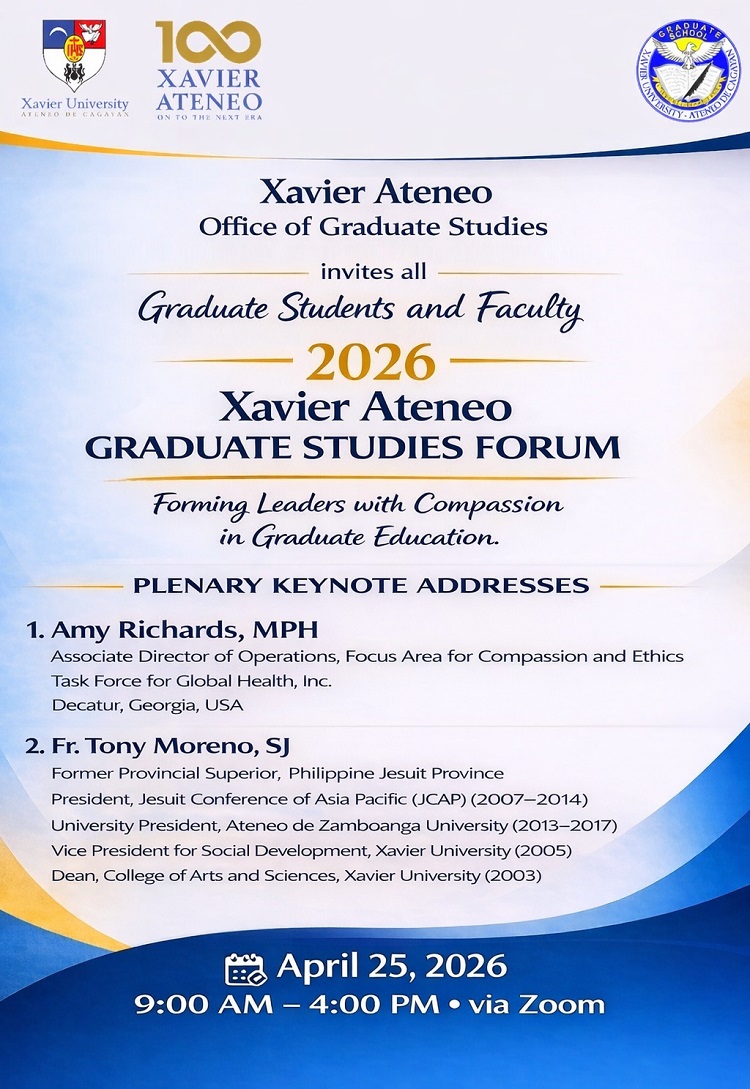
Xavier Ateneo Graduate Studies Forum 2026: Advancing Scholarship with Compassion and Purpose
Xavier University – Ateneo de Cagayan affirmed its commitment to academic excellence and social relevance as it convened the Graduate Studies Forum 2026, organized by the Office of Graduate Studies, on April 25, 2026. The event brought together graduate students, faculty, and scholars across disciplines for a full day of intellectual exchange and reflective dialogue.
Anchored on the theme “Forming Leaders with Compassion in Graduate Education,” the forum underscored a central tenet of Xavier Ateneo’s mission: that leadership in today’s complex world must be grounded not only in competence, but in empathy, ethical discernment, and service to others.
A Platform for Thought Leadership
The morning plenary session set the tone for the forum, featuring two distinguished keynote speakers whose work bridged theory and practice.
Dr. Amy Richards, Associate Director of Operations at the Focus Area for Compassion and Ethics of the Task Force for Global Health, delivered a keynote on compassionate leadership in graduate education. Her address invited participants to reconsider leadership as a relational and ethical practice, one that recognizes human dignity at the core of institutional life.
In equal measure, Fr. Antonio “Tony” F. Moreno, SJ, a respected leader in Jesuit higher education and governance, offered a candid reflection through his keynote, “Imperfect Leadership: Will it still Matter?” His message emphasized humility, discernment, and the enduring value of principled leadership even amid institutional complexity.
Student responses and open forums further enriched these sessions, reinforcing the forum’s collaborative ethos and its commitment to dialogue across levels of experience.
Showcasing Graduate Research Across Disciplines
The afternoon parallel sessions highlighted the breadth and depth of graduate scholarship at Xavier Ateneo and partner institutions. Organized into thematic clusters, these sessions reflected both disciplinary rigor and responsiveness to real-world challenges.
- Organizational Systems and Service Delivery examined how institutions navigated coordination, leadership transitions, and structural constraints, offering grounded analyses using established frameworks such as the Six-Box Model.
- Leadership, Governance, and Institutional Development explored systemic issues in higher education and organizational life, including decision-making delays, leadership instability, and governance complexity.
- Psychology Across the Lifespan brought attention to social and emotional dynamics, with studies on adolescent relationships, mental health literacy, resilience, and workplace well-being.
- Social and Institutional Influences on Behavior addressed public service motivation, organizational engagement, and governance practices in both public and private sectors.
- Psychosocial Dynamics and Resilience in Filipino Contexts examined lived experiences related to retirement, disaster response, and community resilience.
Across these sessions, a common thread emerged: a sustained effort to link academic inquiry with lived realities. Many studies highlighted systemic patterns—rather than individual shortcomings—as drivers of organizational and social challenges. This perspective reflected a mature research culture that values structural insight, contextual sensitivity, and practical relevance.
Bridging Research and Practice
What distinguished the Graduate Studies Forum was its emphasis on “living cases”—research grounded in ongoing organizational, institutional, and community contexts. These studies moved beyond abstract theorizing, offering concrete diagnoses and actionable recommendations for improvement.
Several papers analyzed coordination challenges in higher education institutions, pointing to centralized decision-making structures and uneven resource distribution as recurring issues. Others examined workplace well-being, demonstrating how factors such as mental health literacy, leadership practices, and organizational support systems shaped outcomes for faculty and staff.
In the field of psychology, research presented in the forum addressed pressing concerns such as adolescent peer dynamics, emotional well-being, and coping mechanisms, contributing to broader conversations aligned with sustainable development goals on health, education, and social inclusion.
Forming Leaders for a Changing World
At its core, the Xavier Ateneo Graduate Studies Forum 2026 is not merely a venue for presenting research. It is a formative space—one that cultivates reflective practitioners, critical thinkers, and compassionate leaders.
By bringing together diverse perspectives and fostering meaningful dialogue, the forum reinforces the role of graduate education as a catalyst for transformation—within institutions, communities, and society at large.
As the discussions unfold, participants are invited to carry forward a shared commitment: to lead with competence, to act with integrity, and to serve with compassion.