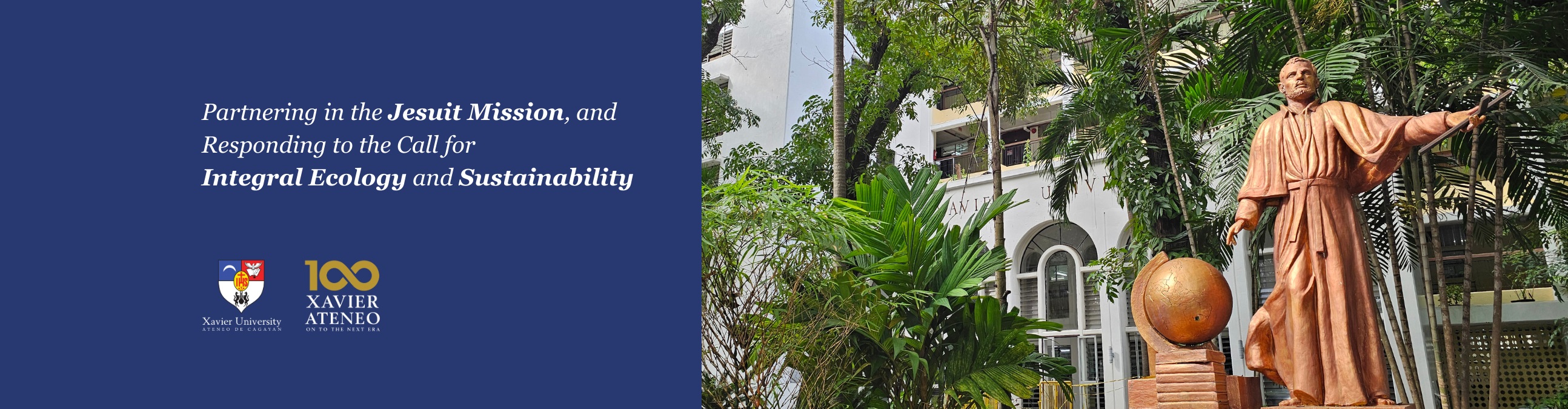
Guided by its Jesuit mission of forming persons-for-and-with-others, Xavier University-Ateneo de Cagayan continues to advance its sustainability agenda through education, research, governance, and community engagement. In line with the United Nations Sustainable Development Goals (SDGs), the university integrates the principles of integral ecology and social transformation into its institutional strategies and academic practices.
This report highlights Xavier Ateneo’s collective action across 17 global goals for 2024—reflecting its enduring commitment to building a more just, sustainable, and compassionate society. Each initiative presented herein represents the university’s unwavering belief that meaningful change begins where learning, leadership, and love for humanity meet.
Advancing Poverty Solutions through Partnership
Sustainable Development Goal 1: No Poverty
Xavier Ateneo directly engaged with regional poverty alleviation by entering a significant partnership with the Provincial Government of Misamis Oriental to serve as the academic lead for its Single Digit Poverty Incidence (SDPI) Program. This collaboration involves the Social Development cluster designing a specialized Multidimensional Poverty Index (MPI) framework, ensuring that provincial anti-poverty strategies are data-driven and targeted. The university also maintains a comprehensive scholarship and financial aid program to ensure that financial constraints do not serve as a barrier to tertiary education for students from low-income families.
Empowering Farmers through Knowledge and Innovation
Sustainable Development Goal 2: Zero Hunger
The university contributed to enhanced food security through applied research and community outreach. The College of Agriculture engaged its Service-Learning students in projects focused on improving yields for partner farmers through applied methods such as soil analysis and post-harvest technology assessments. Furthermore, XU’s Sustainable Sanitation Center (SUSAN Center) continued to research and advocate for the safe reuse of treated human waste in agriculture, promoting resource-efficient food production and a circular economy approach to farming.
Strengthening Community Health through Collaboration
Sustainable Development Goal 3: Good Health and Well-being
Xavier Ateneo strengthened its role in regional public health through institutional collaboration. The university's health clusters signed a two-year collaborative agreement with the Northern Mindanao Medical Center (NMMC) for research and social development focused on community health. Students from the College of Nursing and School of Medicine engaged in extensive community health nursing programs and public health education drives in underserved areas, directly extending healthcare access and knowledge. XU also supported public safety and mental health through its institutional engagement with the City Drug Abuse Council (CADAC).
Driving Social Transformation through Quality Education
Sustainable Development Goal 4: Quality Education
As a mission-driven institution, Xavier Ateneo integrates academic quality with social impact. The university’s signature Service-Learning Program (SLP) is utilized across colleges, requiring students to apply their specialized knowledge—from engineering to nursing—to address complex community challenges, a model showcased at the Service-Learning Summit 2024. This integration was further institutionalized through a grant secured by XU for developing innovative SDG-Driven Courses, explicitly aligning the curriculum with global sustainability goals.
Mainstreaming Gender Justice across Xavier Ateneo
Sustainable Development Goal 5: Gender Equality
Xavier Ateneo promotes gender equality through clear institutional governance. The university maintains and enforces an explicit Non-Discrimination Policy in its employment, admissions, and academic affairs, ensuring equal opportunity regardless of gender or sexual orientation. Furthermore, its institutional commitment ensures that the Gender and Development (GAD) office reviews policies and integrates gender perspectives across university planning and community engagement activities.
Integrating Water Stewardship into Infrastructure
Sustainable Development Goal 6: Clean Water and Sanitation
Significant future-focused investment was made via the development of the Masterson Campus (Campus of the Future). The design includes the planned installation of a dedicated sewage treatment plant (STP) to ensure all water is treated, recycled, and reused on-site. The campus also incorporates water conservation efforts through rainwater harvesting initiatives and the installation of water-efficient fixtures.
Transitioning Toward Renewable Energy Systems
Sustainable Development Goal 7: Affordable and Clean Energy
Xavier Ateneo actively invested in transitioning its energy consumption toward renewable sources. This included the installation of new solar-powered street lights on existing campuses and planning for extensive rooftop solar panel systems for the new Masterson Campus. This commitment to renewable energy was reinforced by the establishment of the P4.99 million DOST-funded Green Bio-Hydrogen to Energy Laboratory at the College of Engineering, focusing on converting waste into clean energy carriers.
Building Inclusive and Productive Communities
Sustainable Development Goal 8: Decent Work and Economic Growth
Xavier Ateneo supported local economic growth by collaborating with the DSWD Sustainable Livelihood Program (SLP) and the DTI-RAPID Growth Project, providing technical assistance and capacity-building workshops focused on micro-enterprise management and financial literacy.
Engineering Smarter, Greener Solutions
Sustainable Development Goal 9: Industry, Innovation, and Infrastructure
Xavier Ateneo established itself as an innovation hub by securing a DOST-PCIEERD grant for its Smart Decision Support System for Waste-to-Energy (WtE) technology. This initiative directly tackles the region's solid waste crisis through advanced research and partnership, promoting sustainable industrialization. Furthermore, the infrastructure of the Masterson Campus, featuring a Detention Pond for flood control and bike/e-vehicle lanes, serves as a model for resilient and sustainable urban development.
Expanding Access and Empowerment for All
Sustainable Development Goal 10: Reduced Inequalities
The university actively reduces inequalities through targeted programs and institutional policies. Xavier Ateneo maintains a strong focus on scholarship programs to reduce economic barriers to education. Furthermore, the Social Development Cluster prioritizes partnerships and programs aimed at addressing the specific needs and marginalization faced by Indigenous Peoples (IPs) and other vulnerable groups in Northern Mindanao.
Designing Communities that Thrive
Sustainable Development Goal 11: Sustainable Cities and Communities
Xavier Ateneo contributed to community resilience through its infrastructure and research. The new campus design incorporates features like a Detention Pond to help manage stormwater and prevent urban flooding. Academically, students in the SLP engaged in Disaster Risk Reduction (DRR) mapping and vulnerability assessments in partner barangays, providing actionable data for local government units to build safer, more sustainable communities.
Sustaining the Cycle of Responsibility
Sustainable Development Goal 12: Responsible Consumption and Production
The university implements rigorous campus stewardship to promote sustainable consumption. XU maintains its high-ranking performance in the UI GreenMetric Ranking through comprehensive operational measures, including running a materials recovery and vermicomposting facility, enforcing strict waste segregation protocols, and continuing the ban on single-use plastics. Research via the SUSAN Center also promotes the circular economy by focusing on resource recovery from waste.
Advancing Climate Justice through Education and Research
Sustainable Development Goal 13: Climate Action
Xavier Ateneo made a definitive institutional commitment by formally embarking on its 7-year journey toward becoming a Laudato Si' University, integrating climate justice and integral ecology into its operations and advocacy. Mitigation efforts include the transition to renewable energy, while adaptation is addressed through high-level research grants secured for GeoDRR and DigiHaz projects, which use technology for enhanced climate risk and natural hazard management.
Protecting Marine Biodiversity through Science and Service
Sustainable Development Goal 14: Life Below Water
The university's contributions to marine conservation are led by the McKeough Marine Center (MMC). The center actively engaged in marine research and education, focusing on aquatic ecosystems and conservation science. The MMC hosted forums and supported student-led coastal projects, including seagrass meadow assessments and educational drives on endangered marine species.
Preserving Forests and Biodiversity for Future Generations
Sustainable Development Goal 15: Life on Land
Xavier Ateneo demonstrated a major commitment to terrestrial ecosystem conservation through the Masterson Campus development plan, which guarantees the preservation of 25 hectares of protected forest and animal sanctuaries adjacent to the new academic area. Furthermore, the university actively runs the Atiman Kinaiyahan program, which involves tree propagation and planting initiatives on XU properties and partner areas, contributing directly to regional reforestation and biodiversity.
Strengthening Institutions through Dialogue and Data
Sustainable Development Goal 16: Peace, Justice, and Strong Institutions
The university contributes to strong institutions by providing data-driven governance tools, such as the development of the Misamis Oriental MPI framework. The university also fostered political participation through events like the DAPAT LANG! Campaign for the Barangay and Sangguniang Kabataan Elections 2023.
Partnering for a Sustainable Future
Sustainable Development Goal 17: Partnerships for the Goals
In 2024, Xavier Ateneo, through its Social Development Office, joined hands with the Philippine Institute for Development Studies (PIDS), Mindanao Development Authority (MinDA), and the Philippine APEC Study Center Network (PASCN) for the Mindanao Policy Research Forum (MPRF). With the theme “Going Green and Digital for Mindanao’s Sustainable and Inclusive Future,” the forum gathered scholars, policymakers, and civil society stakeholders to discuss research and strategies on Mindanao’s twin transition toward digitalization and green growth.
In addition, Xavier Ateneo became a co-recipient of the IPUR Seed Grant, alongside UCL, UoG, and NUS—three of the world’s top universities. The collaborative project, “Affordable and Accessible Decision-Support Tools Against Hazard Risks for Local Communities in Developing Countries,” exemplifies international solidarity in research. This partnership not only enhances local capacities in climate and disaster risk reduction but also positions Xavier Ateneo as a contributor to global best practices in resilience education. The initiative bridges cutting-edge science and grassroots empowerment, showing how meaningful partnerships can create sustainable impact in vulnerable communities.
Subsequently in September 2024, the university collaborated with the University College London (UCL), University of Glasgow (UoG), and the National University of Singapore (NUS) to host a weeklong international training on Infrastructure Resilience Decision-Support Tools. Funded by the Institute for the Public Understanding of Risk (IPUR) under the UNESCO Chair for Disaster Risk Reduction and Resilience Engineering, this initiative equipped engineers, planners, and resilience practitioners from both the academe and government with the technical skills to design safer and more resilient infrastructures. The event blended theory and practice through lectures, field exercises, and technical workshops—reinforcing Xavier Ateneo’s reputation as a Mindanao hub for global expertise in resilience education and disaster risk reduction.
In collaboration with the League of Corporate Foundations, Inc. (LCF), Xavier Ateneo hosted the Corporate Social Responsibility (CSR) University Lecture Series in September 2024. Organized by the Social Development Office, Advancement Office, and several academic departments, the forum brought together business leaders, CSR practitioners, and students to reflect on the evolving role of corporations in society. The School of Education’s Arrupe Educational Center, in partnership with the City Social Welfare and Development Office (CSWD) and the Department of Education’s Alternative Learning System (DepEd-ALS), continues to run the Night School Program (NSP) for out-of-school youth and adults in Cagayan de Oro. The program has produced numerous ALS completers and accreditation passers, proving that education remains a powerful bridge toward social inclusion.
A Network of Hope and Action
Through its diverse collaborations—from international universities and national research institutes to local government units and grassroots organizations—Xavier Ateneo stands as a nexus of dialogue, innovation, and hope. Each partnership reflects the Ignatian principle of magis, the pursuit of “more” for others: more cooperation, more understanding, and more commitment to the common good.
The university reaffirms that sustainable development is, above all, a shared journey—one that thrives in solidarity, guided by faith, science, and love for humanity.
Read more about how Xavier Ateneo advocates for the Sustainable Development Goals through this report.

This report supports all the United Nations’ Sustainable Development Goals.