by Meckhan Tagarda
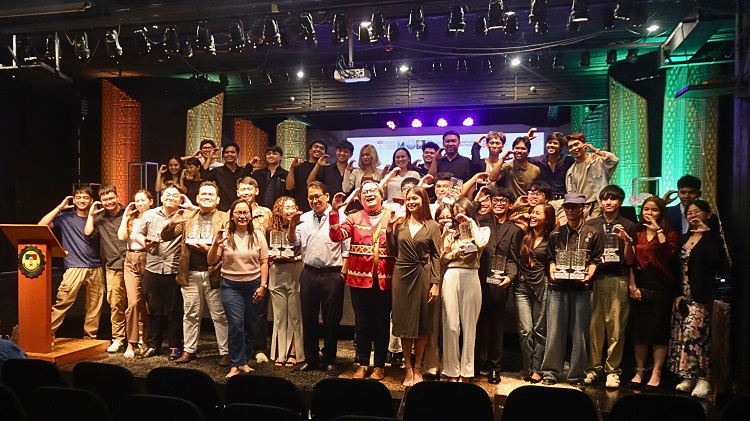
Cinemagis Awarding Photo Opportunity | Photo by Meckhan Tagarda
“When we define Cinemagis, we define first with the celebration of the filmmaking efforts and frontiers,” said Dr Hobart Savior as he quietly watched from the technical booth. From his spot at the back, he wasn’t only looking at the films, but at the audience too.
This year, that same spirit of “doing more” filled the Little Theater of Xavier University as Cinemagis marked its fifteenth year. From 24 to 27 September 2025, the festival once lit up the screens, showcasing 31 films, including special screenings, and celebrated eight filmmakers who competed and carried with them the voices of Northern Mindanao. In between laughter, applause, and quiet reflection, audiences gathered not just to watch but to witness how far a small campus initiative has come—how Cinemagis continues to evolve and redefine what regional cinema can be.
For fifteen years, Cinemagis has been a platform where young, professional, and aspiring filmmakers of Mindanao bring their stories to the screen. The festival has grown into more than just a competition, more than just story-telling. For Dr Hobart Savior, it has always been about the question: What more can cinema do?
The word magis, a Latin term that means “to do more,” comes from Jesuit education. But Dr Savior explains that it is not about doing everything, or doing bigger things, but about doing something with depth.
“It's really about the implications, connotations, the construction of meanings that function in a way that people will understand more of the issues and find solutions to these conflicts. So that's the context of ‘magis,’ where filmmaking should be placed as a very serious point.”
Through the years, Cinemagis has also become a training ground. Many of the entries are made by college students who are holding a camera for the first time, to teachers who are exploring their passion, sharing it with their students to learn how to shape their own voice.
For others, it is their first time to see a local story on the big screen. The festival has turned into a small but steady classroom, one where lessons are not only about cinema but about identity.
“We talk about culture, we talk about folklore, we talk about Mindanao voices [and] aspirations. So the films will definitely be flavored as Northern Mindanao.
Challenges remain; Cinemagis is held in Cagayan de Oro, a city without its own film industry or film school. Budgets are tight, resources are scarce, and most filmmakers juggle studies or jobs alongside their passion. Yet the festival continues. For Dr Savior, this persistence is itself ‘magis’: the commitment to keep asking, keep creating, and keep showing what Northern Mindanao cinema can become.
From Campus Screening to Regional Festival
The idea for Cinemagis was first coined by Fr. Noel Bava, S.J., who was then the Assistant to the President for Culture and Arts at Xavier University. In the year 2007, it began simply as a film education initiative; screening films from various countries to expose students to world cinema and its diverse lens. At that time, Cinemagis was not yet a platform for student works, but rather a window for learning about the art and language of motion pictures.
When Dr Hobart Savior was recommended to serve as Xavier University’s first Director for Culture and Arts; he saw the potential of Cinemagis to grow beyond film education.
“If I have ‘Cine Arte’ the same as ‘Cinemagis,’ then I could be able to use that platform to more instead of just doing film education. But really turn it into a film festival, a competition,” he recalled.
In 2009, the festival officially began the same year Cinema Rehiyon was born, immediately gaining support from the National Commission for Culture and the Arts (NCCA), marking the start of a sustained effort to bring Mindanaoan stories to the screen.
Despite the two-year delay that was caused by the pandemic, Cinemagis, over the years, from what began as a campus activity grew into Northern Mindanao’s longest-running film festival. It has opened its doors not only to Xavier Atenean students, but also to filmmakers across the region: from Bukidnon, Iligan, and Misamis Occidental and Oriental, to other provinces in Mindanao.
And even after the years of quiet brought by the pandemic, Cinemagis returned with a renewed vision, a reboot, as Dr Savior calls it. The festival that once celebrated the potential of Mindanaoan storytellers now enters a phase of rediscovery, rebuilding its frontier while searching for new voices and fresh perspectives. “We’re doing a reboot of Cinemagis to discover again new voices, new breeds of filmmakers,” he said. “It’s just right, and now it’s clear to me what Cinemagis truly is.”
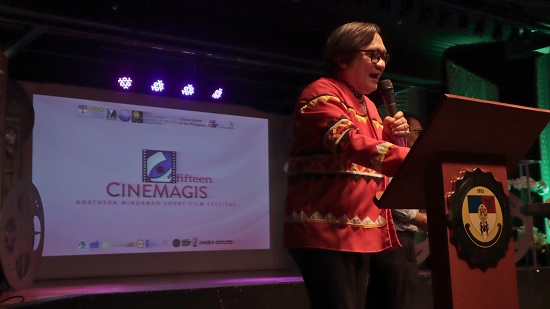
Cinemagis Awarding Opening Remarks | Photo by Meckhan Tagarda
What Does “More” Really Mean?
For Dr Hobart Savior, the meaning of ‘magis’ has never been fixed. Every year, it takes shape through the stories that filmmakers bring to the festival. A short film about a poor man’s decision-making asks: what more can we do to change the system? A student’s documentary on divorce asks: what more should we do to change the culture? Even a simple narrative about a mother and son relationship becomes a quiet reminder of what more human connection can give in times of mental health needs.
These questions are not always answered in the films, but that is the point. The festival has become a space where audiences leave the theater carrying something to reflect on; whether it is about culture, social justice, or even personal life.
“The audiences will always get the point of the filmmakers,” he said. For some, it is the first time they see the realities of Mindanao projected on screen. For others, it sparks curiosity, that if these stories can be told, what other untold voices are still out there?
In this way, ‘magis’ becomes both a challenge and an encouragement. It dares filmmakers to reach deeper, into their creativity and their community with empathy, while also inviting audiences to look closer at their own lives.
[The] reflections of filmmakers about the reverberations of their societies can be examined by the mass, by the people. That's why it's massively seen by many. And we cannot underestimate the audiences.
At its heart, Cinemagis carries the Jesuit value of magis, ’to do more,’ not only for the filmmakers it develops, but also for the nation’s understanding of what Philippine Cinema can become. In giving Mindanaoan stories the big screen to project, the festival expands the frame of national identity beyond Manila-centric lenses.
It asks: what does it mean for cinema to be Filipino if it does not also carry the voices of the Subanons, Mandaya, or the visions of Higaonons, the lived realities of Mindanao?
In this way, Cinemagis does not simply add films to the country’s growing archive; it redefines the very conversation on Philippine Cinema by reminding us that “Filipino” is always plural, layered, and still in the making.
One Word; One Big Region
Cinemagis may be based in the City of Golden Friendship, but its impact has reached far beyond the city. Over the years, several filmmakers who started in Cinemagis have later joined Cinemalaya, Cinema Rehiyon, or even international festivals. Their journeys began with the small but steady push of seeing their story projected on the Cinemagis screen.
The impact also extends to audiences. For many Kagayanons, this festival is one of the times when local faces, dialects, and issues appear in cinema. Watching a story on screen about a barangay they know, a ‘slanguage’ they speak, or a struggle they share, reminds them that their realities are worthy of film.
Beyond its own screenings, Cinemagis has also inspired other festivals to take root. The Northern Mindanao short film festival in Cagayan de Oro showed that cinema could grow even in places without established industries. Across Mindanao, smaller initiatives have looked to Cinemagis as proof that local filmmaking is possible if there is a space that believes in it.
In the city itself, Cinemagis’ influence opened doors for a more public celebration of local cinema. In 2017, the Cine de Oro Film Festival was established by the ‘Imoortal Productions’ headed by Artistic Director Joe Bacus, carrying a different vision but one undeniably shaped by the path Cinemagis had cleared. Unlike Cinemagis, which began within the academic setting of Xavier University, Cine de Oro focused on reaching the wider Kagay-anon community. Its screenings were free and open, its guidelines more experimental, giving room for independent filmmakers outside the university to showcase their voices.
Cine de Oro became that bridge of empowering community-based filmmakers and strengthening the movement for a local cinema identity in the city. Together, Cinemagis and Cine de Oro now stand as two different but related platforms; one rooted in the discipline of learning, the other in the spirit of community expression.
They were part of Cinemagis as alumni. And, of course, now they have their own film festival, we're very proud of that.
Both festivals continue to define local and Mindanao cinema with unique signatures and identity, reflecting restless questions that mirror the act of magis.
Cinema in Mindanao is also becoming a way to reclaim identity and re-root cultural memory. For many filmmakers, telling stories through film is not just an artistic pursuit but a form of cultural reclamation; bringing forward the voices, traditions, and experiences of the region that have long been overshadowed by dominant narratives from Manila or the West.
In the case of Cagayan de Oro, this means rediscovering the local or regional history, language, and the unique character of the city, then projecting them into films that resonate with Kagayanons themselves. By grounding cinema in the community’s lived realities, filmmakers are voicing truth in the film scene as an identity that reflects both the struggles and the pride of the region.

Cinemagis Opening Night | Photo by Meckhan Tagarda
Dr Savior explained that the growth of Cinemagis has been guided by the Jesuit value of magis, “I think because of films, [it] can perhaps help as an art, help shape the minds of people. That's what I think it does as ‘magis’.”
The festival’s growth also highlights the challenges of filmmaking in Mindanao, where, unlike in Luzon and Visayas, an established film industry is almost nonexistent. There are no film academy institutions to back young and aspiring filmmakers, few production houses to provide technical support, and little to no distribution networks to carry films beyond local borders.
For Dr Savior, the gaps in Mindanao’s film landscape are not reasons for despair but reminders of what can still be built. “I don’t want to celebrate the lack,” he shared. “There’s already a presence of what we can offer.”
He believes that institutions like Xavier University and its cultural office must remain persistent in nurturing spaces for cinema. Despite the absence of a formal film school, he finds hope in the communities and movements that continue to champion cinema: Cinemagis, Xavier Center for Culture and the Arts, the Xavier Ateneo Film Society, SINEGANG.ph, Dakila, and others. “I'm always hopeful. That's why we're doing this effort,” he said, manifesting that the future of Mindanao cinema lies in these tireless efforts to make film education accessible, collaborative, and felt by many
As Cinemagis continues to progress, its vision extends beyond the screenings and the awards. “I think the point here is that Cinemagis will become more developmental,” he shared, <ei“so that it can contribute better filmmakers that will, again, contribute to the whole Philippine cinema.”
For Dr Savior, the festival is not just a celebration of finished works, but an invitation to aspiring filmmakers in Cagayan de Oro and beyond Northern Mindanao, empowering them to imagine, and to act on those imaginations
For Dr Savior, the hope for Mindanao cinema is one that is “more enjoyable, more responsible, and more inclusive.” It is not only about producing filmmakers, but about building a network that uplifts one another—a living, breathing community of storytellers.
And, as Cinemagis continues, it strives not to circle within the familiar, but to search for the new: the fresh voices, the emerging ideas, the next storytellers who will redefine what Mindanao cinema can be.
If Cinemagis has proven anything in its fifteen years, it is that films from the margins can move the center; that stories born in quiet classrooms and humble communities can speak to the nation. The challenge now rests with the next generation: to pick up the camera and idealize their imagination for cinema, not as an escape, but as an encounter, framing both sense and sensibility toward the meaning of “more.”
Cinemagis will return this April 2026