Understanding Nature is Understanding People
By Katrina E Daba, 4th year Bachelor in Secondary Education-English
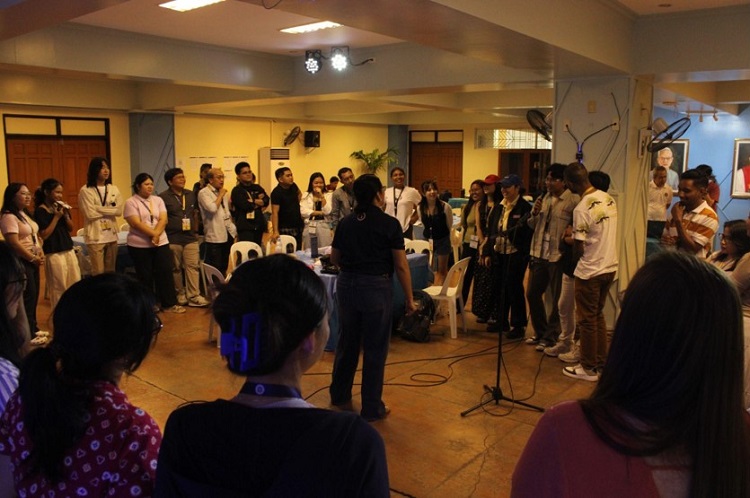
AJCU-AP SLP 2025 delegates sharing their insights and learnings from the sessions through a community circle.
Carried uncertainties, packed with curiosity, and held onto a thin line of excitement. These were the exact feelings that comprised my being before arriving in Naga. These were also the same emotions that made me push forward for the whole duration of the program.
Being selected as one of the delegates of Xavier University-Ateneo de Cagayan and being given the opportunity to represent my own college, School of Education, was a moment that I’d always be grateful for. It opened doors for me that I didn’t know was possible to enter and accomplish. More than anything else, the Service Learning Program (SLP) directed me to connections I didn’t imagine would be significant in looking ahead of the future.
AJCU-AP may have been designed as a gathering to deepen our knowledge and associate ourselves more to the in-depth purpose of service learning, but for me, it served more than its intention. Recalling my 2-week stay in Naga, there was never a dull moment with the people whom I now call friends.
The theme this year is “One With Nature” which indeed lived up to its own message. All the experiences we have had during our community immersions and field exposures, ultimately led us to one thing—understanding nature is understanding the people. The more we interact with people, the more we recognize how they are being affected by nature. The environment couldn’t speak for itself, hence, we rely on the experiences, disturbances, and stories brought and shared by the other delegates. Because of these, we begin to grasp the realities and environmental issues that we are currently facing.
Caring for Mother Nature isn’t a one-time thing—but rather an ongoing commitment. This is similar to how we keep in contact with the people whom we got acquainted with. Constant communication is one of the necessary steps to keep the relationship built.
We cannot always be just “tourists” in nature all the time; we have to go back to the grassroots in order to have a better understanding of what’s going on and how to mitigate the challenges that occur around us.
Beyond Cultural Exchange, Witnessing Lived Realities
By Leigh Kyla Rondina, 4th year BS Development Communication
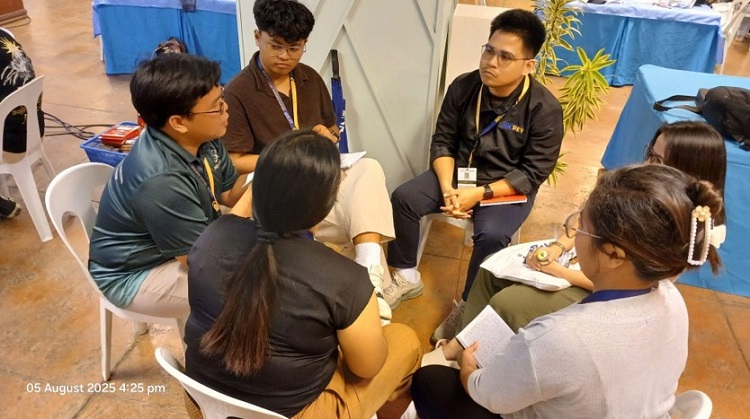
Xavier Ateneo delegation in their reflection session and spiritual conversations.
The Association of Jesuit Colleges and Universities in Asia Pacific (AJCU-AP) Service Learning Program (SLP) offered more than an academic gathering; it became a space where culture, identity, and shared aspirations intersected. What began as an opportunity to represent my home institution transformed into an experience that reshaped my understanding of cultural exchange and the diverse realities of young people across Asia Pacific.
The most striking aspect of the program was the informal yet meaningful cultural exchanges that occurred in the dining hall or when lining up for the food in between sessions. Conversations with fellow delegates from Thailand, Indonesia, and Japan or Timor-Leste revealed both the differences and commonalities of our lived experiences. In moments as lighthearted as debating whether dogs bark differently in our home countries, or as serious as discussing our uncertainties about life after graduation, I realized that cultural exchange is not confined to traditional markers like food, language, or rituals—it is also embedded in humor, aspirations, and daily interactions.
Equally memorable were the evenings after “lights out,” when delegates gathered at the lone corner of the formation center with strong WiFi connection. At first glance, the ritual seemed trivial, even humorous: a group of students from different countries united by the need to update loved ones online. Yet this small moment illustrated something profound—that despite geographical and cultural divides, we are bound by shared desires for connection, belonging, and affirmation.
However, the most transformative part of the program was the two-day immersion in Punta Tarawal, a small fishing community in Camarines Sur. The community’s livelihood depends on crabbing, requiring fishermen to spend long nights at sea. Observing their lives provoked a quiet tension within me: the simplicity of their lifestyle was admirable, but it also raised critical questions. Is this simplicity a conscious choice rooted in contentment, or does it reflect structural limitations that prevent them from envisioning alternative forms of comfort and opportunity? This question underscored the importance of approaching cultural immersion with both empathy and critical awareness, recognizing the resilience of communities while also interrogating the systemic inequalities they face.
Through these encounters, I came to understand culture not as a static set of traditions but as a dynamic and relational process. It is shaped by shared laughter, collective struggles, and the dreams that transcend borders. My AJCU experience reinforced that intercultural dialogue is not only about appreciating differences but also about confronting difficult realities with compassion and responsibility.
Ultimately, the conference deepened my gratitude for the relationships I built and the insights I gained. It reminded me that cultural exchange—whether through late-night conversations, humorous comparisons, or reflective immersion—has the power to broaden perspectives and cultivate empathy. These memories, while personal, carry an academic and moral responsibility: to translate cultural understanding into meaningful engagement with the world around us.
Community Immersion: Not Visitors, But Family
By Zaldy S Ocon, Jr, 4th year BS Marine Biology
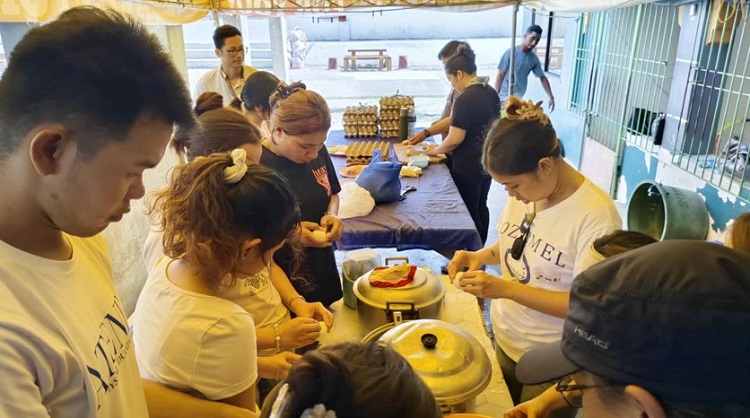
AJCU-AP SLP delegates, in their community immersion, prepare a feeding program for the children and
community of Brgy Punta Tarawal, Calabanga, Camarines Sur.
Words cannot define the kind of emotions I had experienced when we were immersed in the community. It was a roller coaster of feelings. We experienced everything from sadness to happiness. It was during this time that I learned some of life's most valuable lessons.
I used to ask myself whether we were an inconvenience to the people there, but I soon noticed that that was not the case at all. Their love and treatment were so real. They did not treat us as visitors, but as their own children. This helped me realize that it was more than a service with them. It was an actual, two-way care and friendship.
Being immersed in the community, I also learned that one does not need to “live big” to have a good life. I realized that a life in simplicity is one of the best lives you can lead. I found my experience with Nanay Edling, my foster grandmother, to be very impactful; it made me realize that time with our family is invaluable and that all we need to do is to spend it with them. The time we spent together is engraved in my heart. My experiences with them created one of the best memories that I will carry and cherish.
When Industrialization Listens to Nature
By Johnwel Kyle C Amansec, 4th Year BS Industrial Engineering
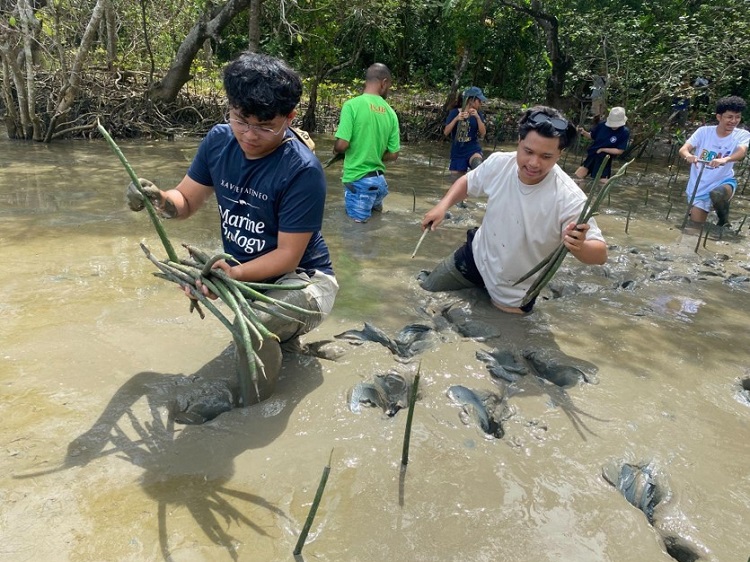
AJCU-AP SLP 2025 delegates planting of mangrove propagules in the coastal area at Calabanga, Camarines Sur.
When I was chosen as a delegate of Xavier University – Ateneo de Cagayan for the Association of Jesuit Colleges and Universities in Asia Pacific (AJCU-AP) Service Learning Program (SLP) 2025, hosted by Ateneo de Naga University, I knew it would be a rare opportunity. But I didn’t realize that in just three days of field exposure I would encounter lessons that would reshape how I view progress, systems, and even my own field of Industrial Engineering.
I was sent as one of the student delegates, and we were accompanied by our XU faculty & formator companions, Ms. Ruby Jane Rivera and Sir John Louis Caga. I walked into experiences where nature, history, and community spoke louder than any classroom lecture.
The heat was sharp when we arrived at the Mangrove Reforestation Activity Site in Calabanga, Camarines Sur. The mud was thick and clung until in the waist, almost pulling us down as we carried seedlings. At first, the mood was light, and I remember “Abo” or Jaturong Sathitpongdet (Student delegate from Xavier Learning Community-Thailand), slipped and nearly fell, and joked that the mangroves were already resisting us. Laughter echoed, but as we pressed each seedling into the soil, the tone shifted. We weren’t just planting; we were fortifying communities against storms, tides, and erosion. Mangroves are protectors. They guard coastlines, cradle marine life, and absorb the impact of typhoons. As I stood there with muddy hands, I thought of systems. In engineering, one weak link can break the chain. Here, each seedling was a link in a living chain of resilience. The message was clear: to nurture the small parts is to safeguard the whole.
The next day, our group hiked to Malabsay Falls in Mt. Isarog Natural Park. The trail was steep, but Alexandre Tavares Martins (Student delegate from Instituto São João De Brito - Timor Leste) took the lead with steady steps, while Sebastianus Gaga Bani (Student delegate from Sanata Dharma University - Indonesia) shared water with those falling behind. We encouraged each other, and when the roaring falls finally came into view, exhaustion gave way to awe. The water cascaded endlessly yet never ran dry. Fallen leaves became nourishment, rocks guided the current, and nothing was wasted. The cycle was whole, self-sustaining. I couldn’t help but compare it to the industries I’ve studied. Many systems chase efficiency but drain resources to exhaustion. Malabsay Falls reminded me that “true systems thinking” isn’t just about maximizing output, it’s about renewal. Progress without renewal, I realized, is only an illusion. As we stood near the falls, delegates slipped on a rock, sending ripples and laughter through the group. Even in reflection, joy flowed alongside learning.
Our last day took us through Naga City’s downtown and riverside, cameras in hand. We explored bustling streets, serene riversides, and historical churches that revealed why Naga is called the “Home of Pilgrimage”. Faith wasn’t hidden inside buildings—it pulsed through the rhythm of the city. At the Museo ni Jesse Robredo, I learned something that left me stunned. The late Mr. Robredo, the man remembered for servant leadership and good governance, studied BS Industrial Management Engineering at De La Salle University-Manila. As an IE student myself, I couldn’t believe the connection. Suddenly, my field felt larger than factories and production—it could be a framework for governance, for listening to people as much as to systems. We met the museum’s architect, who explained how each space was designed with intention, not affecting nature, and turning memory into structure. Aileen Komala Widjaja (Student delegate from Sanata Dharma University - Indonesia) leaned over and whispered, “Imagine if every city had a museum like this.”, and I thought too quietly, “imagine if every leader lived like this.”
The photo walk itself became more than documentation. Hikari Awazu (Student delegate from Sophia University - Japan) captured the vibrancy of street vendors, the clean city and riverside, and I found myself framing not just photos, but stories. Stories of a city where faith, governance, and history intertwine.
The theme of SLP 2025, “One with Nature,” came alive for me during these three days. The mangroves taught resilience, the waterfalls showed balance, and the city revealed how systems of governance and faith can align with nature rather than oppose it. As an Industrial Engineering student, this gave me pause. My field isn’t about romanticizing machines or simply chasing efficiency. It is about systems, and systems only endure if they are sustainable. To be one with nature is not just an environmental call; it is an engineering challenge: to design progress that listens instead of dominates, that renews instead of exhausts.
Within the AJCU-AP context, this is also tied to our Jesuit values, cura personalis (care for the whole person) and being persons for others. I realized that these values must extend not only to people but also to creation itself. To care for nature is to care for humanity. Looking back, the mangroves whispered about resilience, the falls roared about balance, and the streets of Naga spoke of governance rooted in service. Each place was a teacher, and the other delegates were part of the lesson too. We laughed in the mud, cheered each other on the trails, and shared reflections on the riverside. These moments reminded me that transformation is never solitary—but rather it is communal, always to be shared. The greatest lesson I carry is this: industrialization must not silence nature, but listen to it. Systems must not only function, they must endure, and endurance only comes when we walk with nature, not against it.
As I return, I carry not just memories but a conviction, that as future engineers, leaders, and servants, our role is not to leave nature behind in the name of progress, but to design progress that listens, learns, and lives in harmony with it.