By: Mr Ismael B Salarda and Mr Lex C Zulieta
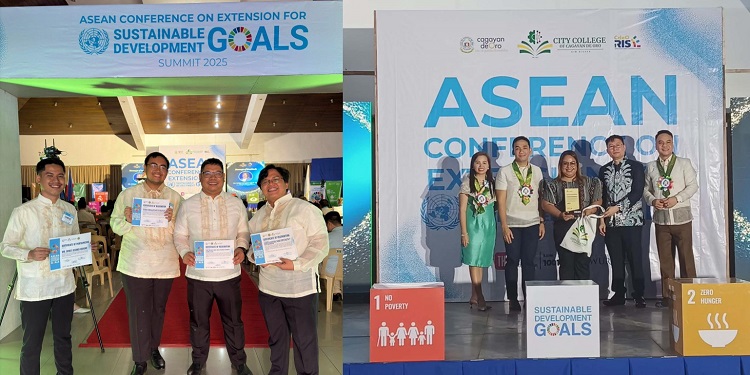
Xavier University - Ateneo de Cagayan was proudly represented by three projects in the inaugural ASEAN Conference on Extension for Sustainable Development Goals (ACES) or the ACES Summit 2025 held on 29 November 2025, at the City Tourism Hall, Cagayan de Oro City. All three extension initiatives earned finalist recognition, underscoring the university's strategic alignment of community-based research and extension programs with global development priorities.
The event was organized by the ASEAN Centre for Sustainable Development Studies and Dialogue (ACSDSD), City College of Cagayan de Oro (CCCDO), and the Philippine Association of Extension Program Implementors (PAEPI). Operating under the theme "Bridging Education and the Community for Sustainable Futures in Southeast Asia," the summit brought together educators, extension leaders, researchers, and development partners to showcase innovative, SDG-driven extension projects as well as strengthen collaboration across institutions and key stakeholders.
Xavier University's participation demonstrated comprehensive engagement across the SDG spectrum, with the University sending three entries through the Social Development Cluster, one for each of the summit's three categories: People, Planet, and Prosperity.
People Category: Xavier University Night School Program-Alternative Learning System
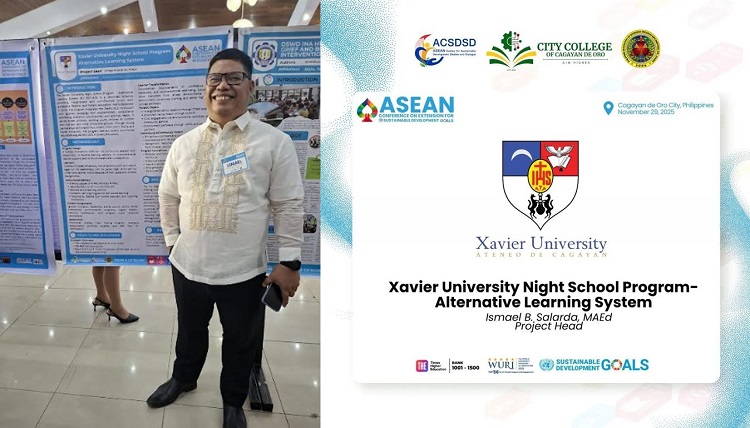
Presented by School of Education (SOE) faculty and Project Head Mr Ismael B Salarda, MaEd, the XU NSP-ALS advances Sustainable Development Goal 4 (Quality Education). The program provides flexible and holistic learning opportunities for marginalized sectors such as out-of-school youth, street children, and those in conflict with the law. By offering evening classes and alternative learning modalities, it "removes barriers related to work schedules, family responsibilities, and geographic constraints, enabling marginalized populations to complete basic education". The initiative is rooted in Jesuit values, combining academic instruction with life skills, leadership training, and values formation.
Planet Category: Integrated Assessment of Coastal Ecosystems and Plastic Pollution
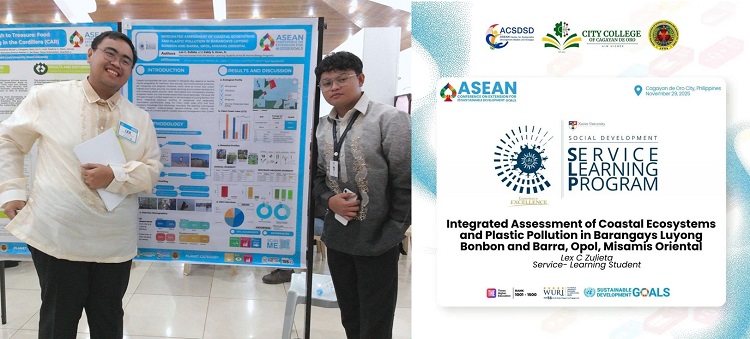
Under the Planet Category, Service-Learning students Lex C Zulieta (BS Marine Bio 3) and Zaldy S Ocon, Jr (BS Marine Bio 4) showcased their project: Integrated Assessment of Coastal Ecosystems and Plastic Pollution in Barangays Luyong Bonbon and Barra, Opol, Misamis Oriental. Anchored on SDG 14 (Life Below Water) and SDG 13 (Climate Action), this research-based extension project examines the dual pressures of plastic pollution and climate change on coastal communities.
Employing field surveys, microplastic and marine botanical analyses, and community interviews, the project "revealed levels of pollution, simple mangal and seagrass meadow structures, and growing socio-environmental concerns such as declining fish catch and underwhelming waste management". These findings have already prompted strong community support for establishing a Marine Protected Area and informed a proposed management plan focused on ecosystem restoration and sustainable coastal resource use.
Prosperity Category: Assessment of Readiness for Digital Transformation
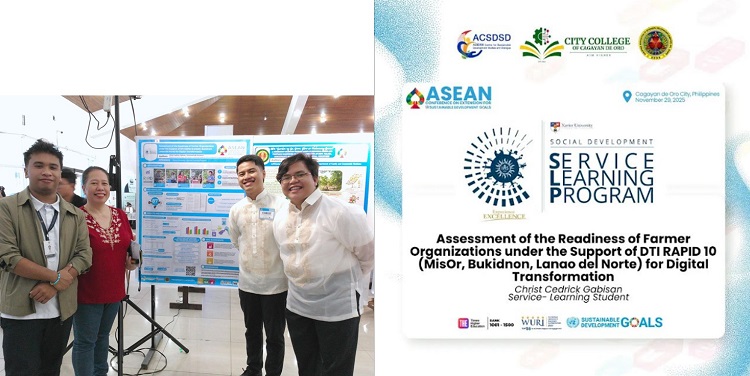
Representing the Industrial Engineering program, Christ Cedrick Gabisan (IE 3) and Johnwel Kyle Amansec (IE 4) presented their project under the Prosperity Category, supporting SDG 9 (Industry, Innovation, and Infrastructure). Their project, Assessment of the Readiness of Farmer Organizations under the Support of DTI RAPID 10 for Digital Transformation, evaluates the digital capacity of farmer cooperatives in Misamis Oriental, Bukidnon, and Lanao del Norte.
Applying advanced statistical analyses, the project found that "most farmers remaining at Industry 2.0, showing strength in basic agricultural modernization while facing significant gaps in digital literacy, advanced technologies, and integrated resource management". The assessment aims to guide strategic interventions to accelerate digital adoption and improve productivity in rural communities.
A Platform for Collaboration
The summit goals were to promote high-impact extension innovations that directly support the United Nations Sustainable Development Goals. The projects underwent a comprehensive evaluation, including an on-site World Café format where presenters engaged directly with panels of evaluators comprising academics, development practitioners, and policy specialists. This methodology enabled a nuanced assessment of implementation challenges and potential for replication across ASEAN contexts.
Beyond the competition, the summit functioned as a collaborative platform. It featured keynote addresses on futures thinking for SDG localization and the ceremonial signing of Memoranda of Agreement among participating institutions to formalize partnerships. Xavier University was joined by 18 other institutions namely, the University of Science and Technology of Southern Philippines (USTP), Liceo de Cagayan University, Salay Community College, Central Mindanao University, Colegio de Kapatagan, Kapalong College of Agriculture Sciences and Technology, Magsaysay College, Eastern Visayas State University, West Visayas State University, Northern Bukidnon State College, Rizal Technological University, Saint Louis University, Mindanao State University, Bukidnon State College, Philippine College Foundation, Tubod College, and Northern Mindanao Medical Center.
At the forefront of all these initiatives, one message resonates: "in a rapidly changing world, localizing and operationalizing the SDGs by bridging education, research, and community engagement altogether creates inclusive, sustainable, and future-ready development initiatives".
Xavier University’s success at the ACES Summit reflects its Ignatian tradition of service, demonstrating how academic institutions can leverage research and student engagement to address grassroots challenges while contributing to national and regional development frameworks.