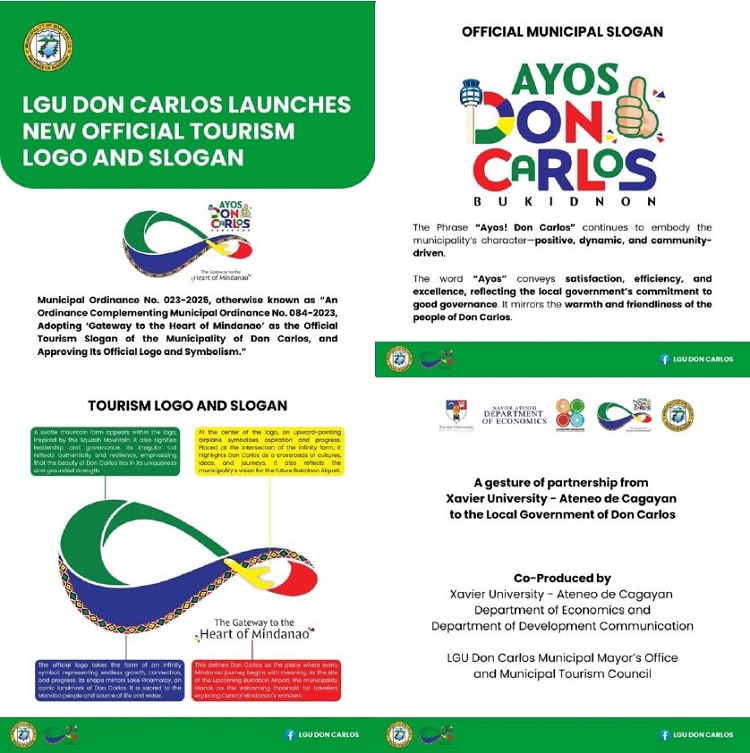
The collaboration between Xavier University – Ateneo de Cagayan (XU) and the Local Government Unit of Don Carlos, Bukidnon has reached a significant milestone with the institutionalization of Development Communication student engagements through Ordinance No 023-2025, alongside Resolution No 002-2026, recognizing the students’ concrete contributions to local development initiatives. This policy move affirms the value of sustained academe–LGU partnerships and formally embeds student engagement as part of the municipality’s development efforts, particularly in tourism.
The engagement involved BS Development Communication students enrolled in the Development Economics course, facilitated by Mr Jhon Louie Sabal, Assistant Professor and former Chairperson of the Department of Economics. Drawing from his academic background and ongoing collaboration with the Municipality of Don Carlos, Mr Sabal anchored the course on the use of economic development principles as the foundation of tourism strategies, allowing students to examine tourism not merely as promotion, but as a development pathway linked to local livelihoods, value chains, and community participation.
Guided by a service-learning framework, the course was intentionally designed to move beyond the classroom and into real-world engagement. Students applied development economics concepts to actual local contexts, working with the LGU to craft communication outputs that reflected Don Carlos’ development goals and tourism vision. The service-learning approach emphasized reciprocal engagement: students learned from the community and local government, while the LGU benefited from research-informed, development-oriented communication outputs.
The field engagement took place from 13 to 16 October 2025, during which students conducted consultations, immersion activities, and collaborative planning with local stakeholders. The culmination of their work was the public launch of their outputs during the Lakeside Coffee Festival on 16 October 2025, led by Governor Rogelio Oñiel Roque of the Province of Bukidnon. This launch positioned the students’ work within an official provincial and municipal platform, underscoring its relevance beyond academic requirements.
The students’ outputs continued to be integrated into municipal activities with a second major public presentation during the Christmas Lighting Ceremony on 5 December 2025, led by Congresswoman Audrey Tan Zubiri, Representative of the 3rd District of Bukidnon. The inclusion of student-generated communication materials in these high-profile events demonstrated how academic engagement, when aligned with local development priorities, can produce outputs that are both timely and policy-relevant.
The passage of the ordinance institutionalizing this engagement reflects the LGU of Don Carlos’ recognition of the strategic role of the academe in local development. It ensures continuity of collaboration beyond a single course, cohort, or academic year, and provides a governance framework that allows student engagement to meaningfully contribute to municipal planning and promotion efforts. The accompanying resolution further acknowledges the role of students as legitimate development partners whose work adds value to local governance.
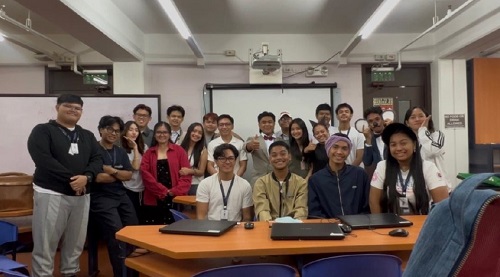
This initiative also highlights faculty expertise as a critical bridge between theory and practice. By integrating his background in development economics and his ongoing work with Don Carlos’ tourism strategies, Mr Sabal was able to translate abstract economic concepts into applied learning experiences. In turn, students gained firsthand exposure to policy processes, stakeholder coordination, and development-oriented communication work—competencies that are difficult to replicate in purely classroom-based settings.
Ultimately, the XU–Don Carlos engagement demonstrates why strong academe–LGU partnerships are essential to development. Universities contribute analytical rigor, critical thinking, and a learning-oriented environment, while local governments provide context, policy direction, and implementation platforms. When linked through service learning and sustained engagement, these partnerships generate outcomes that benefit communities, strengthen local governance, and prepare learners to become development practitioners grounded in real-world experience.
(Teaser) Tourism Promotional Video:
https://drive.google.com/file/d/1E6k8xomYbkLU4lbfBfPQ83xeRczlikBZ/view
(Full) Tourism Promotional Video:
https://drive.google.com/file/d/12zJ1T5ovdMgGZN4koNdKtKsbYnnbcxSb/view