From Cagayan de Oro to Hawaiʻi—SOE students participate in the Spring 2026 Sinag Brownbag,
exploring how language, identity, and pedagogy intersect in multilingual contexts. Supplied photo.
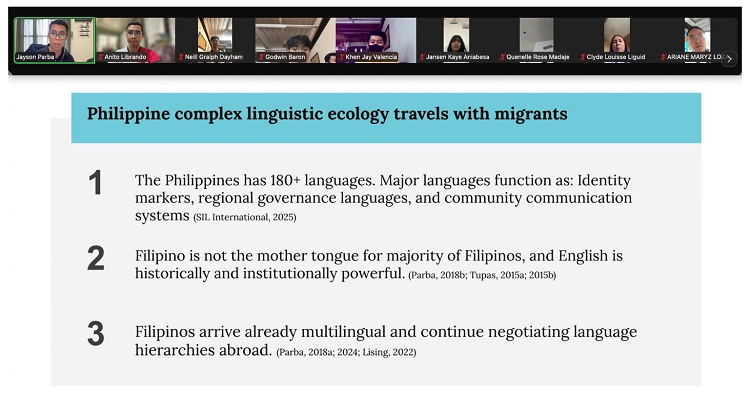
Students from Ed Eng 10: Language Programs & Policies in Multilingual Societies of the Xavier University School of Education participated in the Spring 2026 Sinag Brownbag organized by the UH Mānoa Filipino Language and Culture Program on 10 February 2026, via Zoom. The virtual brownbag served as a venue for engaging with current research and scholarly discussions on Filipino language, identity, and pedagogy in heritage and diaspora contexts.
The brownbag featured scholarly presentations by Precious Arao, Jayson Parba, and Amy Peria, whose talks explored key issues in Filipino language education, including writer identity in heritage language contexts, Filipino as a lingua franca in the diaspora, and measures of complexity, accuracy, and fluency in Filipino writing proficiency. These themes strongly aligned with the course’s focus on multilingualism, language policy, and language ideology. Dr Parba, an undergraduate alumnus of XU SOE, also functioned as moderator for the virtual session.
Guided by their course discussions, students were encouraged to listen critically and reflect on how the presentations challenged monolingual assumptions and highlighted multilingualism as a lived and dynamic reality. The brownbag also allowed students to see how language education functions not only as classroom practice but as a site of advocacy, inclusion, and cultural affirmation.
SOE sophomore Clyde Louisse Liguid reflected on the experience, saying: “When students use their heritage language, they feel proud and learning becomes more meaningful. So, I can say that multilingualism is a skill and not a weakness. It challenges the old monolingual view and supports justice in education by honoring identity and community.”
Minnie Charimaine Valdez, SOE sophomore, emphasized the relevance of the talks to the Philippine context and future teaching practice: “The diversity of Filipino languages reflects the richness of our nation, and for me, the Filipino language serves as a bridge that connects our cultures and strengthens our shared identity.”
Participation in the Sinag Brownbag formed part of a guided instructional activity for the course, prepared by their instructor, Mr Anito R Librando, Jr, with students completing reflective outputs that connected the session to key concepts such as multilingualism as the norm, linguistic human rights, and the role of education in sustaining languages. Through this experience, students were able to engage with international scholars and situate Philippine language education within broader global and diasporic conversations.
The activity reinforced the importance of exposing future educators to authentic academic discourse and underscored the value of integrating co-curricular and global learning experiences into teacher education. As the class continues to explore language policies and multilingual realities, initiatives such as the Sinag Brownbag serve as meaningful platforms for deepening students’ critical understanding of language, identity, and education.