By: Victoria Melissa C Pulido
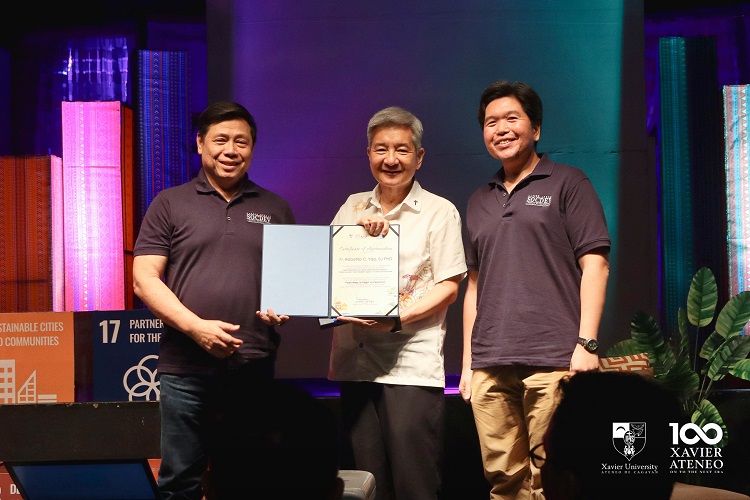
ADMU President and Keynote Speaker Fr Roberto “Bobby” C Yap, SJ, joined by XU President Fr Mars P Tan, SJ
and XU VP for Social Development Engr Dexter S Lo
The Social Development Week 2026 commenced on 2 March 2026, at the XU Little Theater, gathering the Xavier University community to bridge the gap between global policy and grassroots impact through its Keynote and Opening Program, themed "SDGs in Action: From Global Targets to Lived Commitments."
As the keynote speaker, Ateneo de Manila University President and former President of Xavier University – Ateneo de Cagayan Fr Roberto “Bobby” C Yap, SJ, shared Ateneo de Manila’s journey toward institutionalizing the Sustainable Development Goals (SDGs). This integration into university operations has propelled Ateneo de Manila to its current standing as the leading institution in the Times Higher Education (THE) Impact Rankings.
In his opening remarks, Xavier University President Fr Mars P Tan, SJ, emphasized that while the university has long been active in environmental and peace initiatives, citing concrete actions like the ban on single-use plastics and intercultural dialogues, there is a pressing need for a more integrated strategy. "Although we have been doing a lot... we have to learn more from others who are ahead of us," Fr Tan noted, acknowledging Ateneo de Manila’s leadership in global sustainability rankings. "How do we do it more holistically, more comprehensively... and how can we do it sustainably as one [Xavier University] community?"
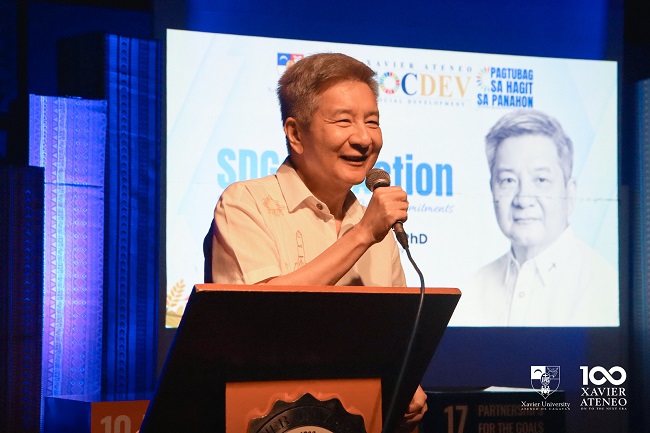
Fr Bobby delivered his Keynote Talk highlighting the best practices of Ateneo de Manila University on the UN SDGs Institutionalization;
Ateneo de Manila University is the leading academic institution in the Times Higher Education Impact Ratings (THE)
Fr Bobby Yap’s keynote provided a comprehensive roadmap for higher education in the "Post-2030" era. He identified four essential functions of a university in achieving the SDGs: impactful research that addresses global questions, quality teaching that embeds sustainability in the curriculum, community extension that supports local action, and framework leadership, where universities guide the government and private sector in building sustainability structures.
To drive this performance, Fr Yap outlined several key drivers that must exist within the university ecosystem. He argued that sustainability requires strong leadership and governance to set policy direction, a strategy that aligns sustainability with institutional priorities, and a culture of engagement that involves the entire community. Furthermore, he emphasized the need for adequate resources and capacity, the acceleration of solutions through innovations and partnerships, and a strict adherence to measurement and accountability to ensure targets are actually met. Finally, he noted the importance of navigating the external environment, including government regulations and public expectations.
He also stressed that true sustainability is not a checkbox but a deeply embedded institutional identity, beginning with leadership and governance. He stressed that a university’s commitment must flow from the top, starting with the Board of Trustees and the President, cascading through Deans and Department Chairs to ensure that sustainability is not just a suggestion, but a clear policy direction.
This structural commitment, however, remains hollow without a vibrant culture of engagement. He challenged the audience to move beyond the idea that social development belongs only to specific offices; instead, he called for a "shared sustainability culture" that actively involves students, faculty, staff, parents, and alumni.
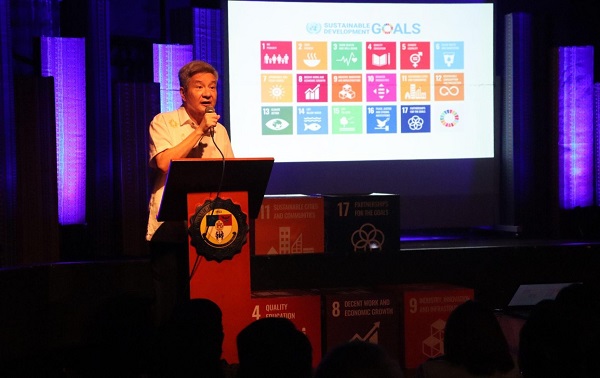
Issuing a wake-up call, he then warned that the world remains "very, very far" from achieving the 2030 targets. He posed a challenge that the university must hold itself accountable through clear reporting and precise metrics, ensuring that every effort translates into measurable progress toward the Sustainable Development Goals.
Sharing best practices, he also detailed Ateneo de Manila’s journey toward becoming a Laudato Si’ University by 2029. He highlighted ambitious targets such as achieving carbon neutrality by 2030 and shifting to 100% renewable energy, a feat already reached across their major campuses through the Green Energy Option. He further discussed evolving goals to include environmental justice, sustainable urban mobility, and the ethical use of AI to ensure technology serves social inclusion.
Beyond metrics, Fr Yap reminded the audience that the foundation of this work is spiritual. "At its heart is really ecological conversion," he stated. "St. Ignatius and his companions did not fear uncertainty... they went to the margins where faith and reason intersected. It is in this spirit that we pursue what we can do as a university." Following Fr Yap’s address are the Responses from Reactors and Honoring of Xavier University’s SDG Champions.
As Xavier University marches toward its centennial, the Opening Program of SD Week 2026 served as more than just a ceremonial start; it was a definitive recalibration of the university’s compass. By framing the Sustainable Development Goals as a "Call of the Times," the assembly made it clear that the path forward requires a blend of academic competence and a compassionate, lived dedication to the marginalized.