By: Paulyn Erica M Porras
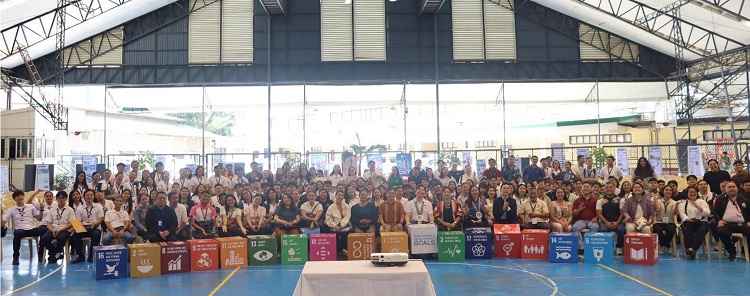
Students, faculty, university administrators, and community partners gather to recognize and showcase student-led
service-learning projects that advance sustainable, locally responsive solutions aligned with the
United Nations Sustainable Development Goals (UN SDGs).
Xavier University–Ateneo de Cagayan hosted the Service-Learning Summit 2026 on 4 March 2026, highlighting the vital role of education in localizing the SDGs as part of the Social Development Week celebrations. The event brought together university and community stakeholders to showcase initiatives that translate academic knowledge into sustainable, community-responsive actions.
The summit gathered representatives from municipal local government units, non-government organizations, and academic institutions across Misamis Oriental, alongside representatives from Ateneo de Davao University, Ateneo de Zamboanga University, the University of Science and Technology of Southern Philippines, Lourdes College, and Liceo de Cagayan University - underscoring a shared commitment to collaborative and community-engaged development.
In his opening address, Vice President for Social Development Engr Dexter S Lo emphasized the importance of grounding academic instruction in community realities, noting that service-learning bridges classroom knowledge with the lived experiences of local communities.
The Service-Learning Program Director, Ms Gail P de la Rita, in her summit overview, underscored the event as a platform for meaningful dialogue and collaboration among academic institutions and community partners, highlighting the importance of shared learning and collective problem-solving.
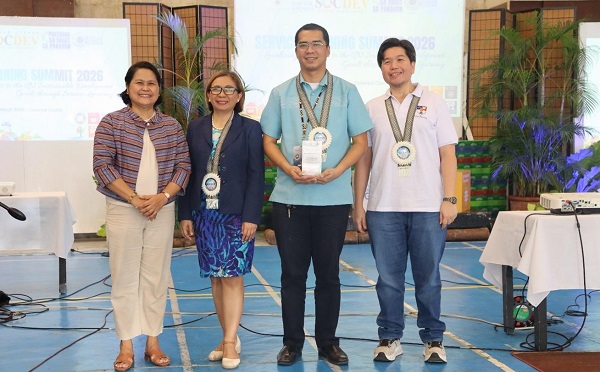
(From L-R) SLP Director Ms Gail P de la Rita, VPHE Dr Juliet Q Dalagan, keynote speaker Mr Daryl Glenn B Pamplona,
and VPSD Engr Dexter S Lo during the awarding of a plaque of appreciation at the Service-Learning Summit 2026
CHED Region X OIC-Chief Daryl Glenn B Pamplona delivered the keynote, emphasizing higher education's role in advancing the UN SDGs. He highlighted how service-learning empowers students to tackle societal challenges—from climate action to economic growth—while aligning academic work with community needs
Vice President for Higher Education Dr Juliet Q Dalagan emphasized that service-learning transcends curricular requirements, framing it as a formative encounter where "academic rigor meets social responsibility." She underscored the program’s alignment with Ignatian pedagogy and outcomes-based education, thereby advancing the University’s mission to address global development challenges.
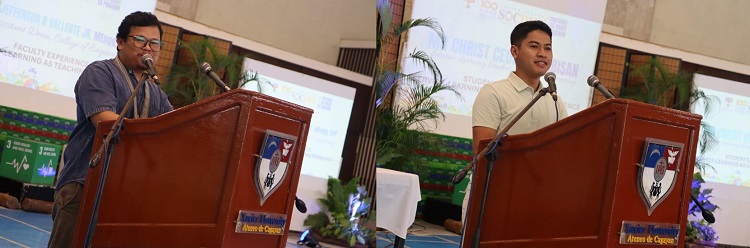
(From L-R) Engr Jefferson R Vallente and Christ Cedrick Gabisan share their reflections and experiences on Service- Learning
From the faculty perspective, College of Engineering Assistant Dean Engr Jefferson R Vallente Jr, described service-learning as a pedagogy that transforms students into active contributors to community development. “Service-learning challenges students to see, hear, and feel the cries of the community, translating technical knowledge into localized solutions that often inform policies and programs,” he shared.
Reflecting on the student experience, Industrial Engineering student Mr Christ Cedrick Gabisan emphasized the personal and professional growth fostered by the program. “Before there were graphs and models, there were conversations, and before there was analysis, there was listening,” he said. He highlighted that service-learning cultivates not only technical skills but also empathy, purpose, and the responsibility to serve communities with integrity.
The summit featured student projects organized into thematic clusters aligned with the UN SDGs. Initiatives under Health and Wellbeing (SDG 3) included dengue vector control, psychosocial support for fire victims, basic life support training, and food sanitation programs. Livelihood and Economic Development (SDGs 1, 2, 5, 7, 8, 9) projects focused on enterprise development, cooperative assessments, feasibility studies, and agricultural and livelihood infrastructure support.
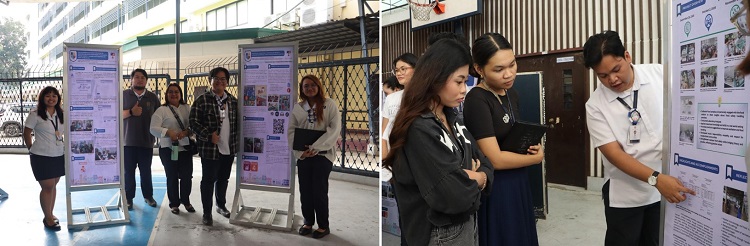
Students present their service-learning projects through poster displays during the Service-Learning Summit 2026.
Moreover, Environmental and Natural Resource Preservation (SDGs 13, 14, 15) included ecosystem restoration, water and forest quality assessments, and carbon sink projects. Sustainable Cities and Communities (SDG 11) addressed infrastructure resilience, flood risk, and adaptive energy planning. Technology Integration and Innovation (SDGs 8, 9) highlighted system designs, feasibility studies, and process improvement initiatives for local governance and enterprises. Projects were presented in a World Café format, allowing community partners and guests to converse directly with students, engage in meaningful dialogue, and listen to their reflections and stories.
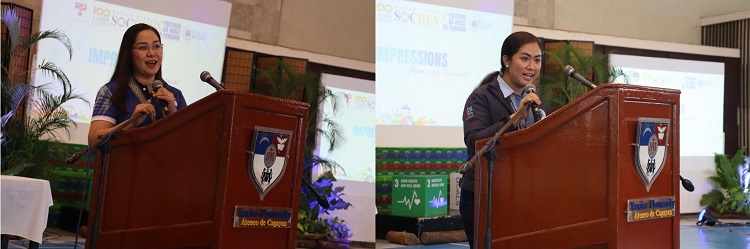
(From L-R) Ms Jocelyn Rosales and Ms Mae Ann Tabanao share their insights and reflections as Service- Learning Partners
Community partners also expressed appreciation for the collaboration. Ms Jocelyn N Rosales, Head of the Special Projects Management Unit of DTI Region 10’s RAPID Growth Project, highlighted that student engagement makes innovation “closer” to communities, transforming technical concepts into practical, accessible solutions. Ms Mae Ann C Tabanao of MORESCO I also shared that the partnership has not only benefited communities but also created collaborators who bring fresh perspectives and renewed hope.
The summit concluded with the awarding of certificates, with students beaming with pride at their accomplishments, faculty expressing pride in their students’ dedication, and community partners showing gratitude for the meaningful collaborations. It was indeed a celebration of shared learning, service, and community impact. By bridging education and community engagement, Xavier Ateneo continues to empower students, strengthen local partnerships, and contribute to sustainable development - demonstrating that learning with service transforms both the student and the communities they serve.