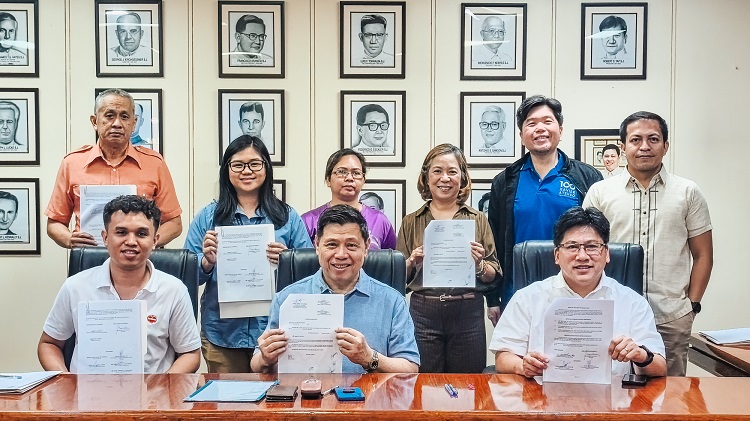
MOU signing ceremony at the President’s Boardroom, Xavier University – Ateneo de Cagayan, 25 March 2026.
Rev Fr Mars P Tan, SJ is flanked by Engr Cel Gaddie Abing (DMPI) and Engr Gerry Napiere (CEPALCO). Also
present (standing, from left): Engr Gunnar Marc Shane Cabaraban; Dr Christine May Salvaloza; Ms Yena Jagunos;
Dr Maria Theresa Isla-Cabaraban; Engr Dexter Lo; and Atty Maynard Eugenio Ylagan.
Xavier University – Ateneo de Cagayan signed separate Memoranda of Understanding (MOU) with Del Monte Philippines, Inc. (DMPI) and the Cagayan Electric Power and Light Company (CEPALCO) on Tuesday, 25 March 2026, formalizing industry partnerships for a government-funded research project that aims to develop a smart decision support system for converting the city’s municipal solid waste into electricity.
Following the signing, the group — joined by representatives from the City Local Environment and Natural Resources Office (CLENRO), the Office of the City Engineer, and the Office of the City Agriculturist — proceeded to a demonstration run of a gasification waste-to-power facility, putting the technology at the center of the project’s research agenda on live display.
The two events capped the first year of the SWEEP CDOC Project, formally titled “Optimizing Urban Sustainability: Empowering Cagayan de Oro City with Smart Decision Support for Waste-to-Energy.” Year 1 was anchored by an earlier milestone — the signing of an MOU between Xavier University and the Local Government Unit of Cagayan de Oro City on 26 July 2025 — which established the city government as a formal cooperating partner in the research. The 2-year project, which officially began on 1 April 2025, is funded by the Department of Science and Technology through its Philippine Council for Industry, Energy and Emerging Technology Research and Development (DOST-PCIEERD) under its grant-in-aid (GIA) program, with a total budget of PhP 16,550,101. It is led by Dr Maria Theresa Isla-Cabaraban of the XU College of Engineering’s Department of Chemical Engineering, whose multidisciplinary team of 13 researchers spans chemical, electrical, electronics, and civil engineering, as well as computer studies. Engr Jodie Rey Fernandez of the University of Science and Technology of Southern Philippines (USTP) contributes his expertise in artificial intelligence.
The MOU signing was held at the President’s Boardroom and was presided over by XU President Fr Mars P Tan, SJ. Supervisor for Renewable Energy Engr Cel Gaddie Abing signed on behalf of DMPI, while Assistant Vice President and Head of Distribution Planning and Development Department Engr Gerry Napiere, and Legal Counsel Atty Maynard Eugenio Ylagan represented CEPALCO. Cabaraban was joined by XU Vice President for Social Development Engr Dexter S Lo, Dean of the XU College of Engineering Dr Christine May Salvaloza, and Chair of the Electrical Engineering Department Engr Gunnar Marc Shane Cabaraban. Ms Yena Jagunos represented Barangay Iponan.
The project aims to develop a municipal solid waste-to-energy decision support system (MSWtE DSS), an analytical planning tool that uses machine learning and multi-criteria decision analysis to help city planners, legislators, and utility providers evaluate and compare waste-to-energy deployment options based on technical, economic, environmental, and social criteria. CLENRO and CEPALCO are among the primary end-users of the system once deployed.
CEPALCO’s role in the project is to supply energy demand data for Cagayan de Oro, which the research team will use to model how much of the city’s electricity needs could be met through waste conversion. According to the project proposal, CDOC’s energy consumption rose from 803 GWh in 2021 to 891 GWh in 2023. Project researchers estimate that diverting roughly 90 percent of the city’s waste to an MSWtE facility could generate approximately 114 GWh, equivalent to about 13 percent of the city’s annual energy demand.
DMPI brings more than a signature to the partnership. The company already operates an anaerobic digestion system that helps power its own facilities — one of the three waste-to-energy technologies under study in the SWEEP CDOC project. Under the MOU, DMPI will share both waste-stream and energy-production data, which the research team will use to train and validate the project's machine learning models. Its involvement lays the groundwork for the public-private partnership the project envisions long-term as part of its sustainability framework.
The demonstration run featured a gasification system, which uses heat to convert solid waste materials, including non-biodegradable plastics, into combustible syngas for power generation. The project studies gasification alongside direct combustion and anaerobic digestion, drawing operational data from partner institutions, the University of the Philippines in Los Baños (UPLB) and Mindanao State University – Iligan Institute of Technology (MSU-IIT), funded by DOST GIA and DOST-PCIEERD GIA, respectively.
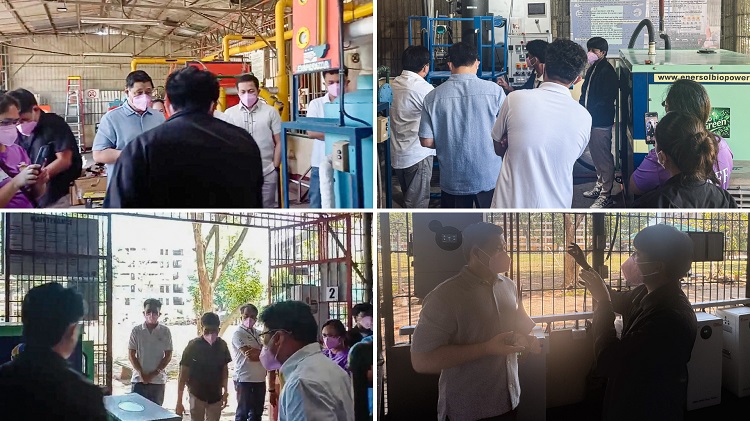
Stakeholders observe the demonstration run of the gasification waste-to-power facility. Representatives from CEPALCO, DMPI, CLENRO,
Barangay Iponan, the Office of the City Engineer, the Office of the City Agriculturist, and the SWEEP CDOC project team are in attendance.
The MOU signings and demonstration run took place one day after President Ferdinand R Marcos Jr signed Executive Order No 110 declaring a State of National Energy Emergency, citing the ongoing Middle East conflict and its threat to the country’s fuel supply. The Department of Energy followed with its own emergency directive on the same day as the XU events, ordering power sector stakeholders to implement fuel conservation measures and maximize dispatch from renewable and indigenous energy sources. In that context, locally generated waste-to-energy power represents exactly the kind of fuel-import-independent electricity supply the government is now urgently seeking to promote.
The SWEEP CDOC project runs through March 2027 and targets the delivery of a fully operational MSWtE DSS, two internationally indexed research publications, and five institutional partnerships. Cooperating agencies include the LGU of Cagayan de Oro City, USTP, MSU-IIT, UPLB, CEPALCO, and DMPI. The project contributes to United Nations Sustainable Development Goals 7 (Affordable and Clean Energy), 11 (Sustainable Cities and Communities), and 13 (Climate Action).
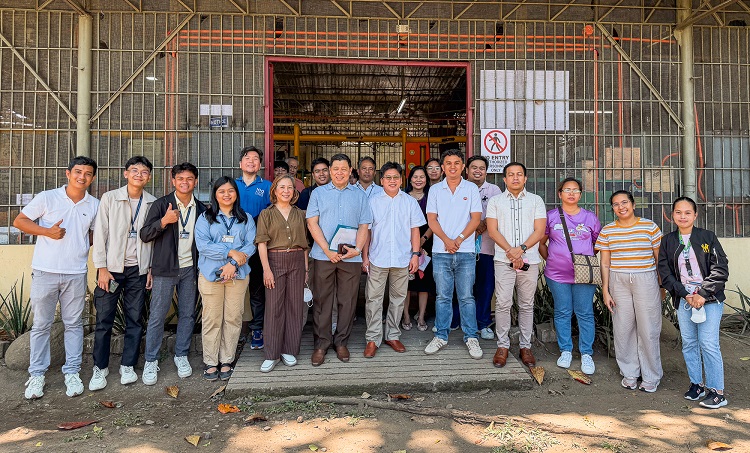
Full group photo of all participants following the gasification facility demonstration run, 25 March 2026.