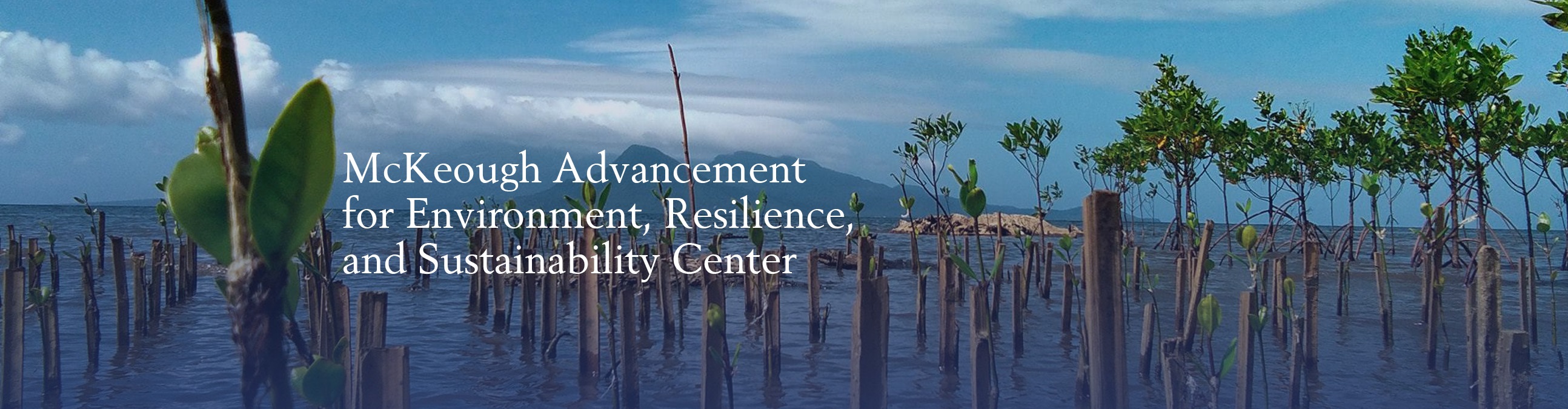
The McKeough Advancement for Environment, Resilience, and Sustainability (MAERS) Center serves as the University’s flagship research and social development unit addressing environmental sustainability and resilience. It focuses on the integrated management of water, land, air, and marine systems, recognizing the ecological connectivity of terrestrial, freshwater, coastal, and marine environments and their collective influence on community well-being.
MAERS Center are focused on the following themes:
- Marine Resilience & Sustainability
- Terrestrial Biodiversity & Sustainability
- Freshwater Management & Resilience
- Extreme Environment Resource Sustainability
- Air Quality and Climate Resiliency
- Natural Products and Bioeconomy
- Clean Energy
History of McKeough Advancement for Environment, Resilience, and Sustainability (MAERS) Center
The McKeough Advancement for Environment, Resilience, and Sustainability (MAERS) Center traces its roots to the long-standing marine research initiatives of Xavier University – Ateneo de Cagayan, particularly through the establishment and growth of the McKeough Marine Center (MMC). For decades, MMC served as the University’s primary hub for marine and coastal research, education, and community engagement, responding to the need for scientific understanding and sustainable management of marine and coastal ecosystems in Northern Mindanao and beyond.
Through the years, MMC developed a strong foundation in marine biodiversity research, coastal resource assessment, environmental monitoring, and community-based resource management. Its work expanded to include capacity-building programs, policy support for local governments, youth education initiatives, and partnerships with national agencies, academic institutions, and local communities. These sustained efforts positioned MMC as a key contributor to marine science and conservation, particularly in Macajalar Bay and its interconnected ridge-to-reef systems.
Recognizing the increasing complexity of environmental challenges—ranging from biodiversity loss and climate change to resource sustainability, pollution, and socio-ecological resilience—the University undertook a strategic expansion of MMC’s mandate. In November 2024, the McKeough Marine Center was formally expanded and reconstituted as the McKeough Advancement for Environment, Resilience, and Sustainability (MAERS) Center. This transformation marked a significant milestone, broadening the Center’s scope beyond marine systems to encompass freshwater, estuarine, terrestrial, and integrated socio-environmental concerns.
Under MAERS, the core marine research, conservation, and management programs of MMC continue, ensuring continuity of expertise, partnerships, and ongoing initiatives. At the same time, MAERS advances a transdisciplinary and systems-based approach, integrating research, instruction, extension, and innovation across key themes such as biodiversity resilience, climate and air quality resilience, natural products and bioeconomy, waste-to-functional materials, clean energy, and sustainable resource management.
The establishment of MAERS aligns with Xavier University’s commitment to integral ecology and its journey toward becoming a Laudato Si’ University. As the University’s flagship center for environmental research and sustainability, MAERS strengthens collaboration with other Social Development Centers, academic units, and external partners, while supporting evidence-based solutions to real-world environmental and social challenges. Building on the strong legacy of MMC, the MAERS Center continues to serve communities, ecosystems, and institutions through research-driven, values-oriented, and impact-focused environmental action.
History of McKeough Marine Center
Because of the scarcity of research and funds in the late 80s and 90s, it could be said that marine research in the university went slack. However, there was a sense of improvement in the 90s as the DA-BFAR gave a grant for resource and ecological assessment in the contiguous bays of Macajalar and Gingoog. This improvement revived the university marine research, paving the way for the renaming of the Institute as the Marine Biological Research Center (MBRC).
Under the leadership of Mr. Michael Atrigenio MSc and with the strong collaboration with the Biology Department chaired by Ms. Perpetua Oloroso MSc, the MBRC thrived well. Moreover, through the support of small-scale grants, the MBRC functioned as an office at the Science Center Faculty Lounge. It had its own research staff, field vehicle, and operational funds. Soon, some problems surfaced in the operations of the MBRC: the departure of Mr. Atrigenio created a leadership vacuum in the MBRC and the insufficiency of short-term grants that were not enough to support the office. These problems contributed to making the MBRC exist only in paper.
In November 2005, upon her reinstatement in Xavier University, Dr. Hilly Ann Roa-Quiaoit initiated the collective restructuring and strengthening of the Marine Biological Research Center in the Biology Department. As a result of this change, the vision, mission and research directions of the newly-revived marine research center were drafted.
The years that followed saw further growth of the Center with more new externally-funded projects onboard through the efforts of Dr. Hilly Ann R Quiaoit. The Macajalar Bay Development Alliance (MBDA) has become the Center’s main outreach program for the member coastal communities. Other project-based initiatives are geared towards strengthening the Alliance. The Center has also started to adopt the Ridge-River-Reef (R3) approach, extensively conducted in the field research by Fr Mars P Tan SJ. The Information Education Campaign (IEC) Program raises environmental awareness that now includes the coastal waters’ connectivity to the river catchment.
From 2011 to 2016, MMC was under the acting directorships of Ms Elaine Villaluz, MSc, Ms Gertrude Garcia, and Dr Hilly Quiaoit, in different years, while its present director, Fr. Mars Tan SJ, was doing his doctoral studies in Australia. During these years, MMC got external grants to finance projects that rehabilitated and enhanced the resiliency of threatened habitats like the Macajalar Bay and the Cagayan de Oro River Catchment through certain novel management frameworks by the local communities and the indigenous peoples. Other projects had focused on the assessment and monitoring of some marine coastal resources such as corals, seaweeds, and dugong in Macajalar Bay and the whole country.
Upon the return of Fr. Tan in 2016, MMC embarked on a new program for high school students, the 5-day marine summer camp while it had continued to engage in externally- funded projects for major marine coastal habitats like the mangroves, corals, and seagrasses in Macajalar Bay. Consultancy work to assist private companies in environmental monitoring has also continued. Engagement with local community partners was also given emphasis to capacitate and empower them for sustainable management of the natural resources.
In 2014, the University inaugurated the new marine station in Jasaan with existing structures that became its dormitory and activity center. The marine station was assigned
Institutional Directives
Vision
Sustainable and resilient management of water, land, air and marine resources in the Philippines especially in Mindanao.
Mission
Dedicated to improving the health and well-being of the seas, rivers, lakes, air and lands of the Philippines especially in Mindanao by engaging communities and partners in co- creation of innovative solutions using interdisciplinary approaches of resource sustainability and resilience.
Goals
The McKeough Marine Center aims to:
- Aid academic units in forming competent and skillful students responsive to the needs of the community and the environment;
- Provide socially significant programs and activities benefitting the local community and the immediate environment;
- Build up the capability of the local communities through participatory activities involving the local people and various multi-stakeholders;
- Provide competent and dedicated faculty equipped to address issues of resilience and sustainability;
- Develop programs, strategies, technologies, and policies that not only help communities withstand and recover from challenges but also ensure continued societal engagement promoting the well-being of current and future generations; and,
- Conduct management and conservation activities from the shores to the mountains of the region addressing contemporary problems and issues.